Open Book: A Charming Typeface for Literary Projects
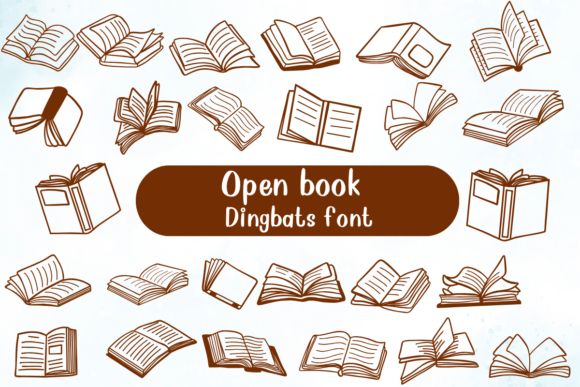
When you need to instantly communicate a love for reading, few design assets do the job quite like Open Book. This isn't your standard serif font or sans serif font; it is a specialized dingbat font composed entirely of hand-drawn book illustrations. In the world of modern typography, functional text is essential, but sometimes a project requires a visual shorthand that words alone cannot provide. Open Book fills that gap by transforming the alphabet into a gallery of charming, literary icons. Each character, from A to Z, represents a unique, open book illustration, offering a whimsical and artistic flair that standard icons often lack.
For designers and content creators, the appeal of this typeface lies in its personality. It doesn’t try to be sleek or corporate. Instead, it embraces a hand-crafted aesthetic that feels personal and inviting. Whether you are working on editorial design, packaging design, or social media graphics, incorporating these hand-drawn elements can soften a layout and make it more relatable. It serves as a perfect counterpoint to cleaner fonts, acting as a decorative element that draws the eye without overwhelming the message. If you are building a brand identity for a bookstore, a library, or an educational platform, Open Book provides a distinct visual language that speaks directly to bibliophiles.
Visual Characteristics and Design Appeal
The defining characteristic of Open Book is its illustration style. Because it is a dingbat font, the "letterforms" are actually vector illustrations. The sketches are typically loose and expressive, mimicking the look of pen-and-ink drawings. This style gives the font a warmth that digital graphics sometimes miss. You won't find rigid geometry here; instead, you see the slight imperfections and fluid lines that characterize handwritten font styles. This makes it an excellent tool for adding a human touch to digital interfaces or printed materials.
As a display font in the broadest sense, its utility is specific. You wouldn't use it for body copy, but for headers, bullet points, or background patterns, it is incredibly effective. The visual weight of the icons varies, providing a natural rhythm when used in a sequence. This organic quality is vital for creative font applications where you want to avoid the sterile feel of stock imagery. By using Open Book, you are not just placing an image on a page; you are integrating a typographic element that aligns with the rest of your layout's grid and spacing.
Practical Applications for Designers and Creators
The versatility of Open Book extends across various mediums, though it shines brightest in specific contexts. For educators and librarians, this font is a practical design asset. It can be used to create engaging classroom materials, reading logs, or bulletin board decorations. Instead of searching for stock photos of books, you can simply type a letter to generate a clean, scalable vector icon. This is particularly useful for print materials where image resolution is critical.
In the realm of publishing and editorial design, the font works well for chapter headers, drop caps, or section breaks in magazines and blogs. It adds a thematic consistency that reinforces the subject matter. For those involved in web design or app development, Open Book can serve as a unique icon set. Imagine a reading app where the navigation icons are consistent with the brand's literary theme, or a blog sidebar where category links are prefixed with these charming illustrations.
Furthermore, consider the impact on packaging design. If you are launching a product line related to literature—perhaps a subscription box for readers or artisanal bookmarks—Open Book can be used on the packaging to create an immediate connection with the target audience. It signals that the product is curated for book lovers. Similarly, for social media graphics, these icons can be used as stickers, bullet points in lists, or background textures to create a cohesive feed aesthetic.
Influencing Brand Perception and Visual Hierarchy
Choosing the right creative font is about more than just aesthetics; it is about psychology and communication. Open Book influences how an audience perceives a brand. It suggests warmth, knowledge, creativity, and accessibility. For a small business owner or entrepreneur in the education sector, using this font can help establish a brand that feels approachable yet knowledgeable. It moves a brand identity away from cold, corporate minimalism toward something more humanistic.
In terms of visual hierarchy, Open Book functions as a strong focal point. Because the illustrations are detailed and distinct, they naturally draw the eye. This makes them perfect for highlighting key information. For example, in a brochure, you might use a bold sans serif font for the headline and Open Book icons to mark the start of each key benefit. This creates a clear path for the reader, guiding them through the content naturally.
Moreover, the font aids in audience engagement. In a digital landscape saturated with generic visuals, a hand-drawn dingbat font stands out. It encourages users to pause and look closer. This increased dwell time can be beneficial for marketing materials and web design. By integrating Open Book into your design system, you create a memorable visual hook that reinforces your message and makes your content more shareable.
Integration and Font Pairing Strategies
Successfully using a specialized font like Open Book requires thoughtful pairing. Because the font is illustrative and whimsical, it pairs best with typefaces that are clean and structured. A geometric sans serif font provides a modern contrast, allowing the book icons to stand out without creating visual clutter. Similarly, a classic serif font can complement the literary theme, creating a cohesive look that feels traditional and authoritative.
When integrating Open Book into your workflow, treat it as a graphic element rather than a text element. Ensure that the size of the icons matches the scale of your surrounding text. Since it is a premium font (or a high-quality free alternative), the vectors are usually crisp, but you should still test how the illustrations render at small sizes, particularly for mobile web design. If the details get lost, the icon may become unrecognizable.
Consider the context of your logo design or layout. If your primary text is a flowing script font, using Open Book might add too much complexity. In that case, use the book icons sparingly—perhaps as a watermark or a singular decorative element. However, if your layout relies on a grid system with a modern typography aesthetic, Open Book can serve as the perfect "break" in the grid, adding personality to an otherwise rigid structure.
Licensing and Final Considerations
Before deploying Open Book in commercial projects, it is essential to verify the licensing terms. As a commercial font, the license typically dictates how you can use the asset. Most licenses cover desktop use for print and logo design, but if you plan to use it in web design via @font-face or in a mobile app, you may need a specific web or app license. Always read the EULA (End User License Agreement) to ensure compliance, especially if you are using the font for client work or mass-produced packaging design.
Ultimately, Open Book is more than just a set of letters; it is a toolkit for storytelling. It allows marketers, bloggers, and designers to inject a sense of narrative and whimsy into their work. Whether you are designing a wedding invitation for a literary-themed event or creating a user interface for an e-reading platform, this font offers a unique solution. By combining the charm of hand-drawn illustration with the utility of a font file, Open Book proves that typography can be both functional and delightfully artistic. It is a valuable addition to any designer's library of design assets, ready to bring a story to life one character at a time.